Mixing My Own Custom Fragrance
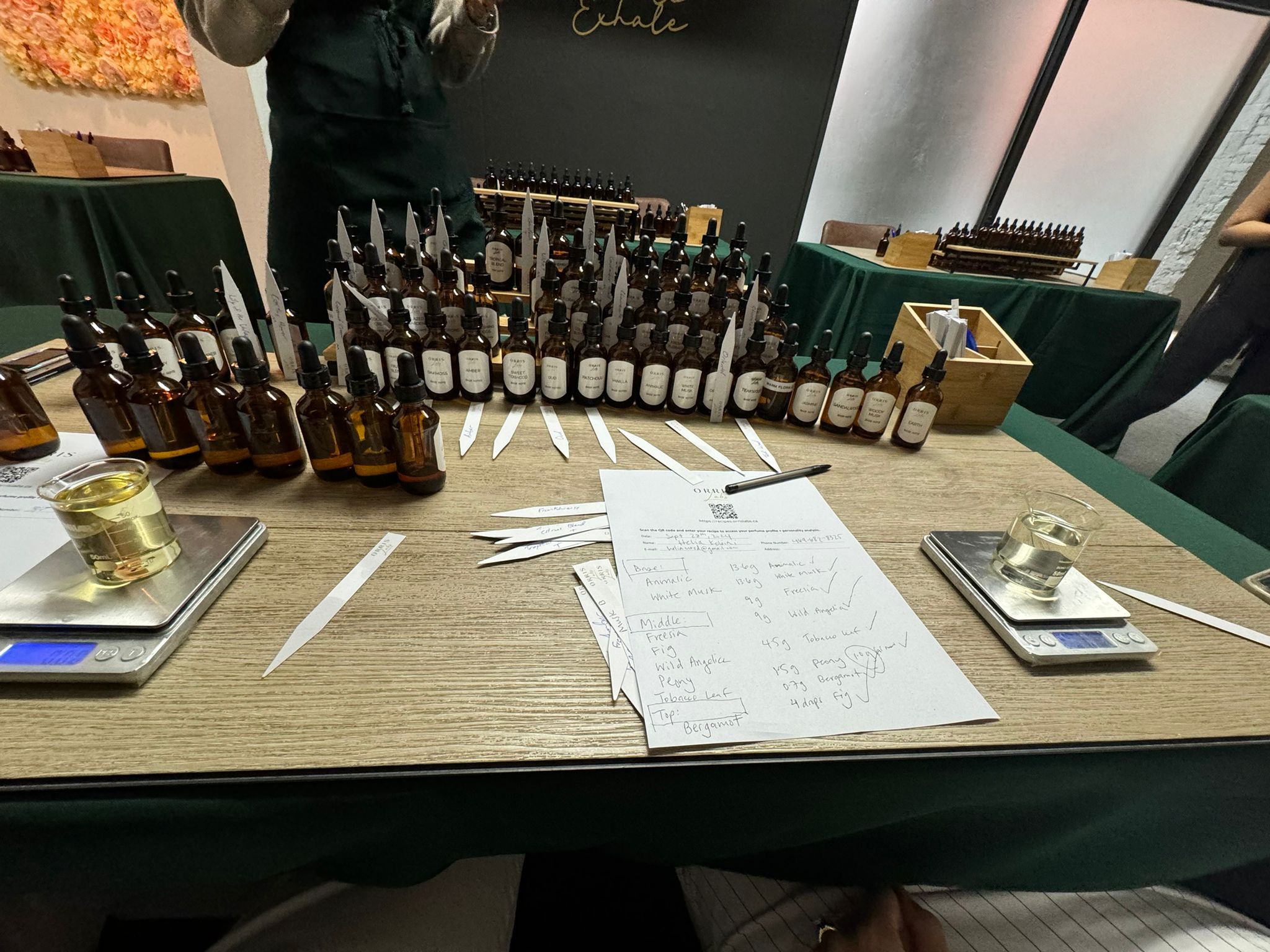
I tried something different: creating a custom fragrance.
At a fragrance-blending workshop, I was given droppers containing a large selection of individual scent materials. The task was to smell them, decide what worked together, combine a few into a formula, and take home the finished blend.
It was less like choosing a scent from a shelf and more like making a small chemical and artistic experiment.
Perfume as Layers
A perfume is usually built from several layers of scent, often described as top, middle, and base notes.
- Top notes are the first scents you notice. They tend to be bright and quick to fade, such as bergamot, lemon, grapefruit, mint, or other citrus and herbal notes.
- Middle notes, also called heart notes, form the main character of the perfume. Common examples include lavender, rose, jasmine, geranium, cardamom, and other floral, herbal, or spicy scents.
- Base notes last the longest and give the fragrance depth. Examples include sandalwood, cedarwood, vanilla, patchouli, amber, musk, vetiver, and frankincense.
The point was not to create three completely separate smells. It was to build a fragrance that changed over time.
Choosing the Ingredients
The workshop supplied many individual fragrance materials in small bottles with droppers.
Some smelled recognisably like their source material: citrus, flowers, herbs, woods, or spices. Others were more abstract-clean, powdery, warm, sweet, smoky, green, musky, or sharp. Perfume can use natural materials such as essential oils and absolutes, as well as aroma chemicals that create or modify specific scent effects.
I worked through the bottles one at a time, smelling each option and taking notes on what I liked. Then I began combining small amounts to see whether the ingredients supported each other or clashed. Frankly I didn’t really know what I was doing.
Mixing a Formula
The actual mixing process was conceptually simple: add drops of chosen ingredients into a small bottle, smell the combination, and adjust.
The difficult part was restraint.
A scent that smelled good on its own could easily overpower everything else in a blend. Adding more of a favourite ingredient did not necessarily make the perfume better. A small amount could add interest; too much could take over the whole composition.
Because the ingredients evaporate at different rates, the perfume also needed time. What smelled promising immediately after mixing could become very different after the lighter notes faded and the base notes became more prominent.
Taking It Home
At the end, I had a small bottle of a fragrance that I had put together myself.
It was a fun experience because it made perfume feel less mysterious. A finished fragrance can seem like a single, indivisible product, but the workshop made it clear that it is a composition of many separate materials, each contributing something at a different point in time.
I still would not claim to understand professional perfumery. But I came away with a greater appreciation for how much trial, balance, and restraint goes into a scent that seems effortless when sprayed from a bottle.