Robot Soccer at the RoboCup Small Size League 2013
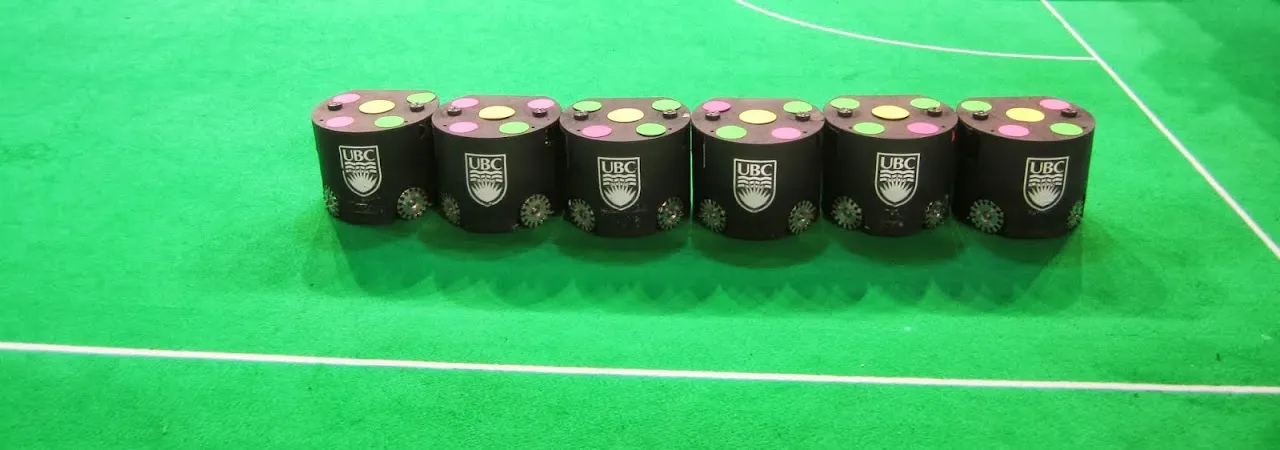
In 2013, the UBC Thunderbots travelled to Eindhoven, Netherlands for RoboCup.
The previous year, I had designed the dribbler. This time, I worked on the chip-kick system: the mechanism that launches the ball into the air or shoots the ball in a straight line.
The goal was straightforward: build a kicker that was more durable, and more maintenance-free than the previous year’s design.
The Previous Kicker
The 2012 robot used a larger, flat solenoid and a flat kicker plate.
The flat plate was easy to manufacture with a water-jet cutter, but it was not especially durable. Repeated kicks-and especially accidental impacts with immovable objects or other robots-could bend the plate. Its return system also relied on rubber bands, which could shred during a match and leave the robot without a reliable kicker.
For 2013, I wanted to make the mechanical assembly smaller, easier to build consistently, and much more robust in competition.
A Smaller Round Solenoid
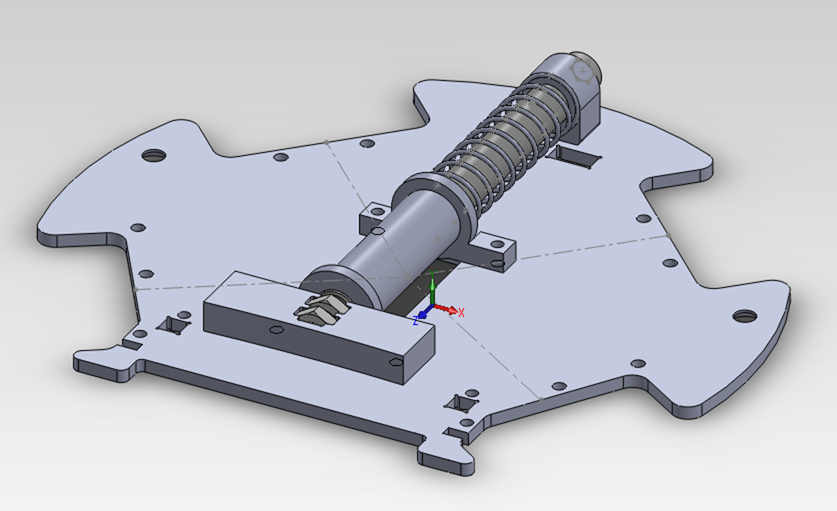
I replaced the previous large, flat solenoid arrangement with a smaller, round, push-type solenoid.
Reducing the size of the solenoid reduced the size of the overall mechanical assembly. It also made assembly faster and reduced tolerance problems that had shown up when building the previous design.
The goal was to preserve at least the prior kicker performance while fitting the mechanism into a more compact and repeatable package. The league target was a ball speed of at least 8 m/s.
The Plunger and Kicker Head
I designed a stronger plunger from two 10 mm-diameter metal sections.
The rear section used mild steel because it has high magnetic permeability, so the solenoid could pull it effectively. The front section used stainless steel. Because the stainless-steel section was non-magnetic for this application, it extended the plunger toward the ball without materially interfering with the magnetic interaction between the coil and the mild-steel section.
I sized the plunger so that the kicker head contacted the ball when the mild steel was centred in the solenoid, where the magnetic force was greatest.
The front face of the kicker head had a concave profile with a focal point of approximately one metre. Compared with the previous flat face, that profile improved kicking accuracy. The 10 mm plunger diameter also addressed a known failure mode from earlier designs: plungers yielding after impacts during play.
An Electromagnetic Impulse
The electrical system used the same nominal capacitor supply as the 2012 robot: four capacitors providing a total capacitance of 4 mF, charged to 240 V.
Four capacitors were charged through a booster circuit. When the robot needed to kick, the system discharged their stored energy into the coil over a very short period. The resulting magnetic field pulled the steel portion of the plunger through the coil, accelerating the crescent-shaped kicker head into the ball.
This is different from the magnetic-field problems I had encountered in school.
Many introductory examples involve a steady magnetic field, or a rotating field in an electric motor. The kicker was neither of those. It was an impulse problem: store electrical energy, release it quickly, create a strong but brief magnetic force, and turn enough of that energy into plunger and ball motion.
I wanted the ball to reach roughly 10 m/s. In practice, that made efficiency the central design problem: the more effectively the system transferred energy from the charged capacitors to the plunger and then to the ball, the faster the kick could be.
Trying to Model the Coil
I looked at coilgun designs online and tried to use FEMM to simulate the electromagnetic system.
FEMM is useful for modelling electromagnetic fields, but I did not have a deep understanding of how to model this particular transient system. A static or rotating magnetic-field model is easier to reason about than a coil that is energised for a fraction of a second while its steel plunger moves through the field.
The important questions were not only:
- How strong is the magnetic field?
- Where does the field concentrate?
- How much force does the coil apply to the plunger?
They were also:
- How does the force change as the plunger moves?
- How quickly does the capacitor voltage fall during discharge?
- When should the coil stop receiving energy?
- How much of the stored electrical energy reaches the ball rather than being lost as heat, resistance, or residual motion?
I did not fully solve the magnetic analysis, but the simulations and research still helped guide the design. More importantly, I ended up with a practical mechanism that was stronger and more robust than the previous version. But I could not really “quantify” anything
A Better Return Mechanism
I also replaced the rubber bands.
The new kicker used an actual spring and a metal stopper to return the plunger to its original position after each kick. The spring provided a more predictable return force, while the stopper established a physical resting position for the mechanism.
RoboCup 2013
The Eindhoven competition was a major improvement over the previous year from a robot-hardware perspective.
After a full year of redesign work, the team arrived with substantially more robust mechanical and electrical systems. The robots no longer suffered the same level of electrical-board failures, and the rebuilt mechanical systems held up well enough that the major limitation became software integration and field testing rather than basic hardware reliability.
The robots could drive, but the software team had not had enough time to fully test the new code with the completed machines. During early matches, the robots struggled to approach the ball, recognise possession, and decide what to do after receiving it. Those issues were frustrating, especially because the mechanical systems were ready to play.
Despite those limitations, Thunderbots finished ninth out of 22 teams-the best result in the team’s history at that point. The team went 2–2 in the group stage, narrowly lost a Lucky Loser shootout against ODENS, and missed the quarterfinals by one final shootout attempt.